
This article is based on the broadcast from the YouTube channel “Rios Art(アート百花)“.
For the original Japanese article, please visitnote.com.

Hello, everyone. Today, I’d like to share the story of how I became a painter—a journey full of detours and unexpected turns.
As subscribers to my newsletter may already know, I did not take a straight, conventional path to where I am today. To be frank, my early years were marked by a series of failures and missteps. But if my story can offer even a small sense of comfort—showing that it’s completely fine to take a long way around in life—I would be very happy.
Xuanzang in the Encyclopedia
My very first memory of wanting to become something was around the second or third grade of elementary school. I happened to watch a television drama about Xuanzang (the legendary monk from Journey to the West), and it deeply fascinated me.
Curious, I looked him up in our home encyclopedia. There, it was written that Xuanzang was a historical figure who traveled all the way to India to bring back sacred scriptures.
I was shocked. Until then, I had only seen the lighthearted TV version, but realizing that someone had actually dedicated their life to such a perilous physical journey blew my mind.
I began to think: “I want to become someone like that. I want to go to India and bring back scriptures.”
Of course, looking back as an adult, I wasn’t living in ancient times, nor did I have a clear understanding of what “bringing back scriptures” actually entailed. It was just an innocent, naive childhood dream. But that early longing for a quest—a journey to find truth—never really left me.
The Old Woman at the Used Bookstore with a Wooden Ruler
As I grew older, an unexpected encounter changed the direction of my life during my student days.
Near my university, there was an old-fashioned second-hand bookstore run by an elderly couple. The shopkeeper, a very strict older woman, always held a long wooden ruler in her hand. If she caught anyone standing there just reading without buying, she would loudly slap the ruler against the counter—thwack!—and scold them.
Naturally, most students avoided the shop. But for some reason, I kept going back.
One day, she suddenly reached for a stack of books and handed me a set of German language textbooks.
“Yuko-chan, these are very good books,” she said. “I’m selling them to you.”
Surprised, I asked her why she was offering them to me. She looked at me sternly and said, “I only want to sell these to someone who will actually study them seriously. If you take these, make sure you study hard enough so you can read them properly.”
I was astonished. I thought to myself, “What a strange and intense person!” But at the same time, it felt like a calling. I felt that studying German wasn’t just about learning a language; it was about stepping into a larger world.
Driven by her words, I began studying German with intense focus. I enrolled at the Goethe-Institut in Tokyo and spent my days taking classes and working part-time at a fast-food restaurant near the university to pay for my studies.
Everything Made Sense in Brussels
Eventually, I made my way to Germany. Back then, traveling abroad wasn’t as accessible as it is today, so even getting permission to go was a challenge.
Equipped with a Eurail Pass, I traveled across Europe, staying in youth hostels. That trip turned out to be a major turning point. Traveling alone through unfamiliar countries forced me to confront myself deeply.
At the same time, one persistent question kept gnawing at my mind: “What on earth is contemporary art?”
I couldn’t understand it. The abstract works, the conceptual installations—none of it made sense to me.
The answer came unexpectedly in Brussels, Belgium.
I visited a museum where works by Piet Mondrian, Wassily Kandinsky, and other masters were displayed chronologically. As I walked through the gallery, watching how art evolved over time, a sudden revelation washed over me. Everything clicked into place.
I realized how human expression had gradually stripped away the unnecessary to arrive at pure, essential forms.
And right then, another realization hit me with immense clarity: “Here is my space. There is a gap left here just for me.”
I saw that within the vast history of art, there was still room for my own unique voice and technique. I felt a surge of certainty: “I cannot spend my life doing anything else. I have to paint.”
Eight Years with a Lid on My Passion
However, returning to Japan meant facing reality.
Back home, the overwhelming experience I had in Europe felt distant, like a dream. People around me expected me to get a stable job, fit into society, and live a conventional life. So, I put a lid on my passion for art and spent the next eight years trying to conform.
I took jobs in teaching and art institutions, trying my best to do what was considered “right.” But living against my true nature took a heavy toll.
I tried so hard to be helpful, to give back, and to do what others asked of me. Yet, no matter how good my intentions were, things kept going wrong. Misunderstandings arose, and I found myself in painful, confusing situations.
Humans are fragile. When you try to live a life that isn’t truly yours, life has a way of throwing obstacles at you until you pay attention.
Looking back, I don’t regret those eight years. They were difficult, but they taught me invaluable lessons about human nature, patience, and what happens when you deny your inner voice. That period of struggle was necessary for me to fully embrace my path later on.
Choosing My Own Adventure
Eventually, I couldn’t hold it back any longer. I left the security of formal employment and dedicated myself fully to painting.
In the beginning, many people criticized my approach. Because my work didn’t fit neatly into existing art categories or trends, people often told me: “You don’t understand how the art world works,” or “You’re taking such an inefficient detour.”
I didn’t fit into any conventional box. But I knew what I had seen in Brussels. I knew the artwork that only I could create, using my painstaking scratch and hatching techniques, was worth bringing into the world. I had no choice but to keep painting.
Gradually, as I kept creating with unwavering dedication, people began to connect with my work.
Artists often feel pressured to compromise—to adjust their style to fit market trends or cater to what galleries want. But I believe you must never betray your own vision.
This journey was an adventure I chose for myself.
Even if it looked like a long, painful detour from the outside, it was the exact path I needed to walk to find my true voice as a painter.
Thank you very much for reading.

2025, oil on canvas,97×130.3cm (F60号)
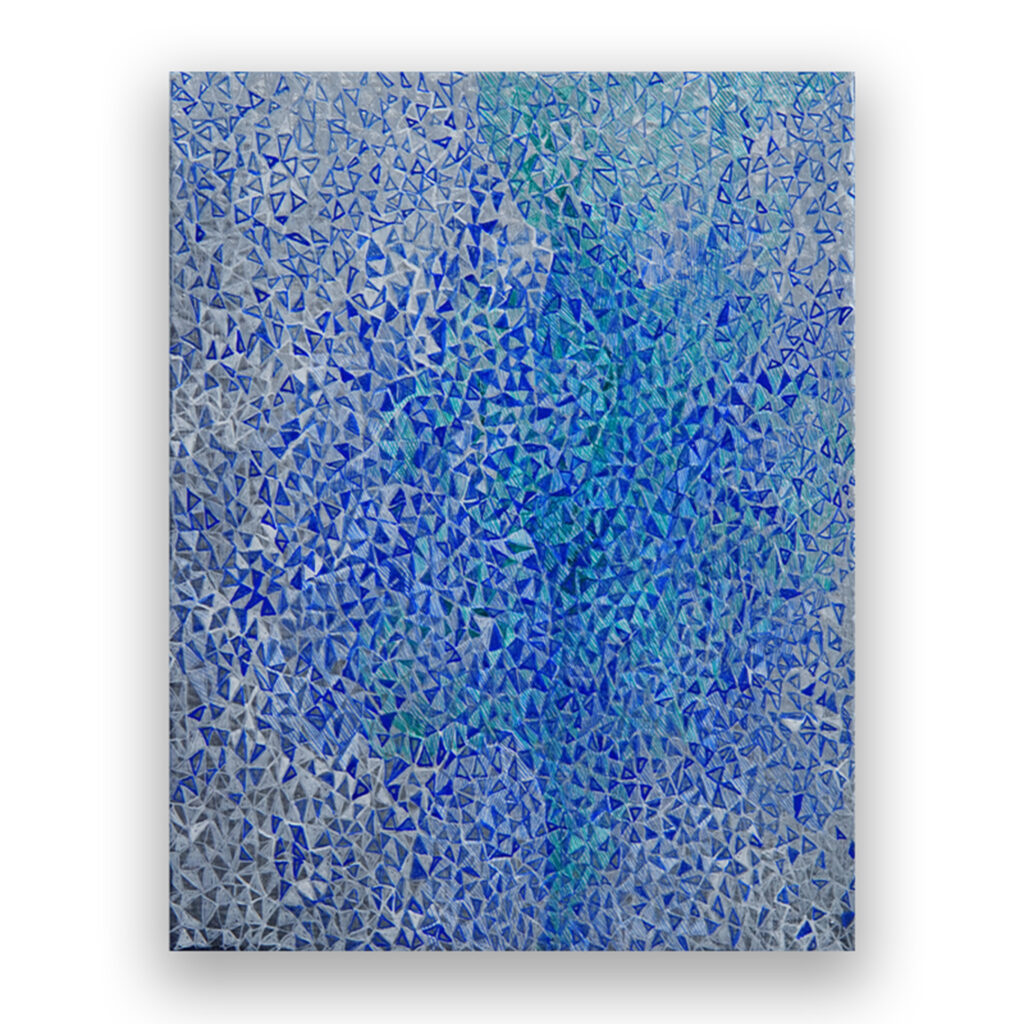
2026, hatching
acrylic gouache on canvas,14x18cm
Links & Notes
- Original Article: Read the original Japanese version on note.com.
- YouTube Channel: Listen to the audio version of this story on our channel, Rios Art.
- Follow: If you enjoyed this post, please follow for more updates on art and creative insights!
About the Author: Yuko Kawada
Contemporary Artist & Painter
Graduate of Tokyo University of the Arts. After encountering contemporary art during her studies in Germany and Brussels, she established her atelier in Kanagawa in 1996 and continues her creative journey exploring light, depth, and texture.