
日本語
画家川田祐子のニュースレター@No.2
1月は、長野市内でもめずらしく雪が降り積もりましたが、ここ数日、日中の春のような陽射しで雪もかなり解けはじめました。それでも夜になると、零度を下回る温度になります。私は珍しく、数年ぶりに風邪をひきました。寝込む程ではありませんでしたが、最初は背中から、その後に喉と鼻に来ました。ショウガをたっぷりすりおろした酒粕を甘く煮立てて、身体を温めて治しました。
どうぞ皆様も、風邪に充分気をつけられて、この冬をお過ごし下さい。
画家 川田 祐子
作品「山は動く」
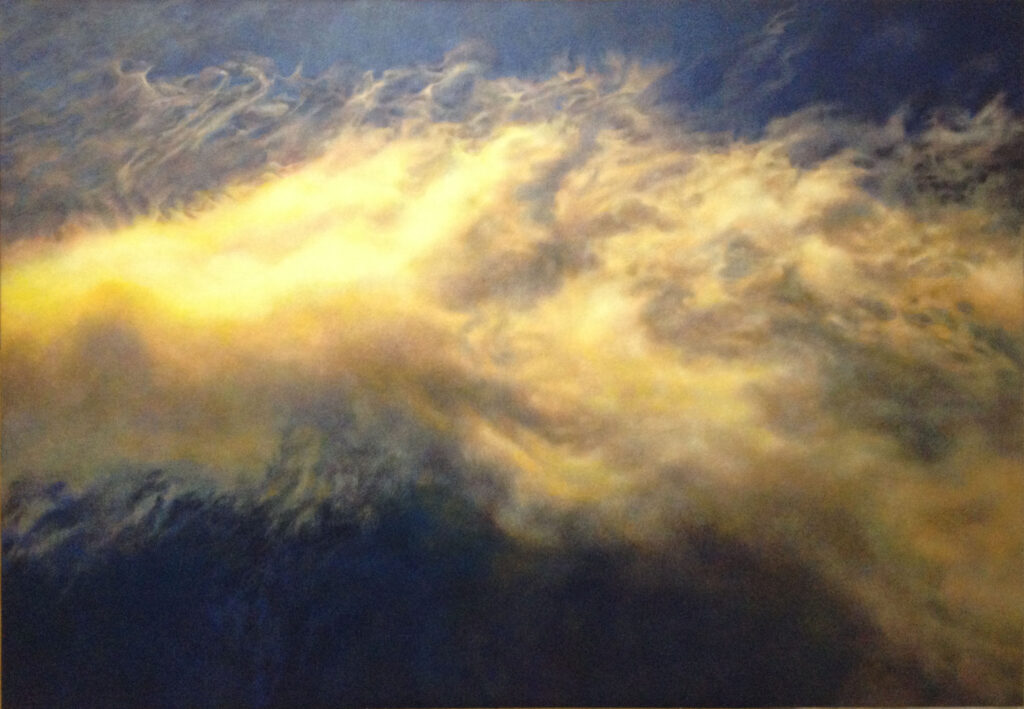
山は動く
2014
hatching
acrylic gouache on canvas
113x162cm
この作品は、当初上下を逆さまで制作していた作品です。夕方住まいの近辺を散歩していた時に、上空に浮かんでいた黄金色の大きな雲から制作のヒントをもらったものです。
そしてこの制作を進めてしばらくして、2014年9月27日に、長野県と岐阜県の県境にある御嶽山が噴火しました。若く将来に希望を持って山歩きを楽しんでいた人たちの大切な人命が、誰も予測する事が出来なかった天災によって、一瞬のうちに失われたのでした。あらためて、海にしろ山にしろ、自然が美しくやさしく穏やかな側面ばかりではない事を知った出来事となりました。表立って意識していなかったものの、この山を「御嶽山」として、昔の人々が畏怖を持って自然崇拝をして来た意味を思い知ったのでした。
この作品が完成を迎える手前では、また今度は長野で最大震度6弱を記録した、2014年長野県神城断層地震も経験しました。実はその日忘れもしない11月22日の朝に、私は右耳が全く聞こえなくなり、近くの耳鼻科を受診しました。医師によると「突発性の難聴だけれど、ことによると今晩あたり目眩があればメニエール病という可能性もあるので、祝日明けにもう一度受診に来て下さい」と伝えられたのでした。帰宅後しばらくして、医師の予告通りに立っていられない程の目眩がはじまりました。わかっていたので、とにかくじっと横になるしかできませんでした。1時間くらいして自然に眠ってしまい、夕方には、その目眩は治まっていました。
ところがその日の夜10時半頃にアトリエでの制作を終えて廊下に出た瞬間に、この地震がドスンとやって来たのです。最初は、自分の目眩だと勘違いし、あまり慌てることがありませんでしたが、ドスンという音とともに、実はこの作品がイーゼルから落ちたのです。たまたま片付けの後でしたから、まわりに物もなく、作品は無事でした。しかしその時に、この作品を上下逆さまにするきっかけとなりました。逆さまにした瞬間に、御嶽山の噴火の事など、自分が制作中に体験した気持ちがよりストレートに出ると感じたのでした。
自然を美しく描く作品は、先人達が数多く残しています。しかし、「3.11を経験した私たちにとって、自然はそれほど生やさしい姿だけではなくなっているのではないか?」と思うようになりました。絵画は、歴史的にも室内の装飾的な役割だけを担って来たわけではないのです。この『山は動く』という作品は、そういう意味で、美しいだけではない、自然の厳しさや奇怪さ、不可思議さによって、暗示や警告という側面も意識的に残すようにした作品でした。
画家川田祐子自伝:虹色の帽子
父はいつの頃からか、高嶋易断を勉強していたようで、「神田の加藤先生」というところへ、幼い私を連れて訪ねることがありました。北鎌倉の土砂災害をきっかけに、今で言う風水を考えた新居の図面をいよいよ自分なりに作って、先生に見てもらい、一大決心をして家を建てることにしたのでした。
鎌倉からの移転先は、神奈川県の三浦半島で探し当てた、海も山も近い、静かで暖かな北下浦という土地。そこはそれまで桃の果樹園だった場所でした。父にとっては、桃源郷(=ユートピア) という意味もあって即決断出来たのでした。しかし、その土地は関東大震災の時に大きく動いた活断層のすぐ近くでもあったので、人の住みたがらない土地になっていました。当時はもう大正時代の大地震などすっかり忘れられていましたが、トラックで何度も山から沢山の土を運び入れて、家の土台を築き、前庭、中庭、裏庭にさまざまな竹を生い茂らせたということでした。父は、竹の由来を中国の竹林の七賢のお話で説明していましたが、地震に備えてのことでもあったようです。
若かりし頃の父(当時まだ40歳に達していませんでした)は、大風呂敷を広げるようなところがあって、無一文にも関わらず、いろいろな人を説得して家を建ててしまいました。家の敷地の北西にあたる一番端の離れには、二つ目のトイレが備え付けられて、北海道から私にとっての祖父を呼び寄せて一緒に住まう予定だったようです。母はそれを聞いて、断固として反対したと言います。結果、最終的には母の不思議な願掛けが効き過ぎたのか、祖父はその家が建つ1か月前に亡くなってしまったのでした。私が男であったなら「一王」という名前を用意していた祖父とは、とうとう一緒に住まうことはありませんでした。私には「祐子」という名前が贈られました。そして、その離れが私の部屋になったのでした。
母屋から扉を2カ所開けて、ガラス戸で囲まれた渡り廊下を行き、また扉を開けて、そのまた障子を開けたところにある6畳間が私の部屋となりました。寝るために自分の部屋に行く時は、一人きりでは寂しかったせいか、必ず父と母におやすみなさいというだけでなく、様々な知っている人の名前を並べ、最後には天国の皆さんにも「おやすみなさい」と言ってからでないと部屋に行けない日がしばらく続きました。
部屋には、古い観音開きのガラス扉がついた本棚があり、その本棚の一番下に大きな引き出しがあって、中に沢山のクレヨンや色鉛筆がザラザラと詰まっていました。絵を描くのが好きと知っている人たちから貰った物ばかりでした。買っても後から後から新しいクレヨンが届いて増えて行くのでした。そのクレヨンを持って、幼稚園に通うようになりました。
バスで10分くらい三浦に向かう所に、母方の祖母が幼稚園を経営していたのです。はじめて描いた絵を今でも私はよく憶えています。幼い子供ながらに、複雑な心境を体験したからです。その日、はじめて新しいクレヨンを使うことになって、自分なりにとても緊張して、なかなかいつものように絵が描けませんでした。それでも絵は描きたいと思い、左から右へ、全部の色をただ並べて塗り始めたのです。すると、ちょうど虹色のように色が並んだのでした。「きれいだなぁ」と見とれていると、先生が「もうそろそろお絵描きの時間は終わります」と言います。私は慌てて、これは何とかしなければと思い、その虹色の帯を一つの枠で大きく囲い、その下に円盤を描いて、更にその下に人の顔を描きました。何となく頭でっかちな人になっておかしかったのですが…。その絵を帰りに持って帰ることになりました。
丸めた画用紙を持って、幼稚園を出るとすぐに祖母の家があって、いつものように寄り道しました。まだお嫁入り前の叔母たちが「何を持っているの?」と聞くので、「今日お絵描きしたの」と見せると、叔母二人は目をまん丸にして、「これ誰なの?」と聞くので、「虹色の帽子をかぶった人」と言うと、二人はきゃっきゃっ笑って「素敵な帽子ね。これかぶったら幸せになれそう。」とすごく喜んでいるのでした。私はこの時の記憶がずっと今でも忘れられません。自分がちょっと変かなと思ったことでも人が喜んでくれたからです。絵を描くのがますます楽しくなった出来事でした。実は30歳を越えたある日に、この出来事をふと思い出す事が出来て、私は絵の極意を幼い自分から教えてもらった気がしたものです。
このように、三浦半島での穏やかな幼少期を過ごしている何気ない日々に、ある時私はいつものように祖母の家に寄り道しようとした最中に、ふと前を見ると、大好きな幼稚園の先生が向こうから笑顔で手を振っているので、「せんせい!」と言って、走り始めた瞬間に、なぜかつまづいて、近くにあった金物のバケツの縁で眉間を三日月に切って、そのまま意識を失いました。「いたいっ!」と自分の声で気付いた時には、病院で治療を受けていたのでした。(次号につづく)
Q & A:作品展示用品
作品を展示するための金具をホームセンターで探す人が多いようです。近くに画術店や額縁店があれば、もっと簡単に相談出来ますが、展示用品と言っても、商品の名称がわからないと、お店で相談しにくかったり、インターネットで検索することが出来ません。そこで、お役に立ちそうなwebサイトをご紹介致します。
【株式会社 福井金属工芸】 ピクチャーレールや美術金具の製造販売会社です。 http://fukuikinzokukougei.com
- 「額縁裏ゴム」1個40円から販売: http://fukuikinzokukougei.com/item_category/item11-09額装やキャンバス作品の傾きを修正したり、微振動による壁面へのダメージを防ぎます。
- 『ワイヤーセット』 1セット60円から: http://fukuikinzokukougei.com/item_category/item10-07キャンバス作品を壁面に取付ける場合に、作品裏の上から5~10cmの高さ、左右両木枠の内側に取付けるヒートンとワイヤーがセットになっています。
- 『額吊金具』1個50円から: http://fukuikinzokukougei.com/item_category/item3-01一般的にフックとも言われています。いろいろな種類がありますが、ステンレス製が錆びないのでお勧めです。これを壁に取りつけ、作品裏の紐を掛ければ、画鋲などよりもより専門的で安全に取付けることが出来ます。但し、壁を傷つけることが出来ない場合は、また別の方法を次回ご紹介致します。
『福井金属工芸』さんは、商品説明もわかりやすく、また手頃な値段で、展示用品を販売しているwebサイトです。是非参考にしてみて下さい。
近況
今年に入って、油絵具でスクラッチやハッチングができないかどうか、いろいろ研究しています。1月は、佐藤一郎翻訳のマックス・デルナーやクルト・ヴェールテの『絵画技法書』を調べて、結果、エッグテンペラ技法に挑戦しています。
顔料(シュミンケ・ピグメント) そのものを何色も買い込み、その顔料に新鮮な卵黄とダンマールワニス、長期間太陽光に晒して作るサンシックンドリンシードオイルと水を混ぜて、水溶性でかつ乾くと溶けないテンペラ絵具を自家製でつくっています。
テンペラ技法を使うと、かなり細かい線の描写が可能になります。顔料は、膠で溶くと日本画になり、アラビアゴムと混ぜれば水彩絵具となり、蜜蝋と混ぜればエンカウスティック (蝋画) も描けます。しばらくは、作品の発表よりも、画材や技法の研究をする時間も大切にしながら制作して行く予定です。
お知らせ
Yuko Kawada Official Siteでは、「Collectors Collection」というページを新たに増設しました。川田祐子作品をご自宅で楽しんで下さる方々をご紹介するページです。 http://kawadayuko.jp/collectors-collection/
前回のニュースレターのアンケートに答えて下さった方の声や、ご所蔵作品の展示風景などを、今後も随時ご紹介していくつもりです。今後も是非ご協力の程、よろしくお願い致します。(かわだゆうこ)
「画家川田祐子のニュースレター」は、
応援して下さる方々に向けて、
毎月5日に手動で配信するメルマガ・サービスです。
次号は3月5日の送信予定です。
YUKO KAWADA Official Site
http://kawadayuko.jp
English version
Painter Yuko Kawada’s Newsletter No.2
Although we had a rare heavy snowfall in Nagano City in January, the spring-like sunlight over the past few days has started to melt the snow considerably. Still, temperatures drop below freezing at night. For the first time in several years, I caught a cold. While I wasn’t bedridden, it started in my back and then moved to my throat and nose. I cured it by warming my body with sweet amazake made from sake lees and plenty of freshly grated ginger.
Please take good care of yourselves and stay warm this winter.
Painter Yuko Kawada
“The Mountain Moves”
The mountain is moving
2014
hatching
acrylic gouache on canvas
113x162cm
This piece was originally created with the canvas upside down. The inspiration came to me during an evening walk around my neighborhood, sparked by a large, golden cloud floating in the sky above.
Shortly after I began working on this painting, on September 27, 2014, Mount Ontake—located on the border of Nagano and Gifu prefectures—erupted. Precious human lives, young people filled with hope for the future who were enjoying mountain hiking, were lost in an instant due to a natural disaster that no one could have predicted. It was an event that served as a stark reminder that nature, whether sea or mountain, does not only possess gentle, beautiful, and peaceful qualities. Though not consciously aware of it at first, I truly came to understand why people in ancient times held awe and reverence for nature, worshiping this peak as “Mount Ontake”.
Right before this artwork reached completion, we also experienced the 2014 Nagano Earthquake (Kamishiro Fault Earthquake), which recorded a maximum seismic intensity of lower 6 in Nagano. On the morning of November 22nd—a day I will never forget—I suddenly lost hearing in my right ear and visited a nearby ENT clinic. The doctor told me, “It’s sudden sensorineural hearing loss, but depending on whether you experience dizziness tonight, it could also be Meniere’s disease. Please come back for another examination after the holiday”. Shortly after returning home, just as the doctor had warned, I experienced severe dizziness that rendered me unable to stand. Knowing what it was, I simply laid down and stayed still. After about an hour, I fell asleep naturally, and by evening, the dizziness had subsided.
However, around 10:30 PM that night, the moment I stepped out into the hallway after finishing my creative work in the studio, the earthquake struck with a heavy thud. At first, I mistook it for my own dizziness and didn’t panic much, but along with the thud, this painting actually fell off the easel. Luckily, since I had just cleaned up, there were no surrounding objects, and the artwork was unharmed. That moment, however, became the catalyst for turning the painting upside down. The moment I flipped it, I felt that the emotions I experienced during creation—including the eruption of Mount Ontake—were expressed much more directly.
Predecessors have left behind countless artworks depicting the beauty of nature. However, I came to think: “For us who have experienced 3.11, nature is no longer something that shows only a gentle face”. Historically, painting has not merely served a decorative role for interior spaces. In that sense, “The Mountain Moves” was consciously created to leave behind aspects of implied warning and omen—reflecting not only nature’s beauty, but also its severity, strange power, and mystery.
Autobiography of Painter Yuko Kawada: The Rainbow-Colored Hat
At some point, my father began studying Takashima Ekidan (traditional Japanese fortune-telling), and he would take my young self to visit a place called “Master Kato in Kanda”. Prompted by the landslide in Kita-Kamakura, he eventually drew up plans for a new house based on what we now call Feng Shui. After having the master review the plans, he made a grand decision to build our new home.
The relocation destination from Kamakura was a quiet and warm piece of land called Kitashitoura on the Miura Peninsula in Kanagawa Prefecture, close to both the sea and the mountains. It was a site that had previously been a peach orchard. For my father, the location signified a peach blossom spring (= Utopia), leading him to make an immediate decision. However, because the land was located right near an active fault line that had moved significantly during the Great Kanto Earthquake, it was a site where few people wanted to live. By then, the great earthquake of the Taisho period was entirely forgotten by most, but my father had truckloads of soil brought in from the mountains to build up the foundation, planting various dense bamboo groves in the front, middle, and back yards. He explained the origin of the bamboo through the story of the Seven Sages of the Bamboo Grove in China, but it was likely also a preparation for earthquakes.
In his youth, my father (not yet 40 years old at the time) had a tendency to talk big, and despite having no money to his name, he managed to persuade various people and built the house. In a detached cottage located at the northwest corner of the property, a second restroom was installed, as he planned to invite my grandfather from Hokkaido to live with us. Upon hearing this, my mother firmly opposed the idea. In the end, perhaps my mother’s mysterious prayer worked too well—my grandfather passed away just one month before the house was completed. Thus, I never lived with the grandfather who had prepared the name “Ichio” for me if I had been born a boy. Instead, I was given the name “Yuko”. And that detached cottage became my bedroom.
To reach my room from the main house, I had to open two doors, walk down a glass-enclosed corridor, open another door, and slide open a paper screen (shoji) to enter a 6-tatami mat room. When going to my room to sleep, perhaps because I felt lonely being by myself, I spent a period where I couldn’t go to sleep unless I said goodnight not only to my parents, but listed the names of various people I knew, and finally said “goodnight” to everyone in heaven.
In the room stood an old bookshelf with double glass doors, and in the bottom drawer, there were tons of crayons and colored pencils jumbled together. They were all gifts from people who knew I loved to draw. Even without buying them, new crayons kept arriving and accumulating. Carrying those crayons, I began attending kindergarten.
About a 10-minute bus ride toward Miura, my maternal grandmother operated a kindergarten. I still clearly remember the very first drawing I made there, because even as a young child, I experienced complex emotions. That day, using brand-new crayons for the first time made me quite nervous, and I couldn’t draw as freely as usual. Still wanting to draw, I simply started coloring from left to right, placing all the colors side by side. When I did, the colors lined up just like a rainbow. As I sat mesmerized thinking “How pretty,” the teacher announced, “Drawing time is almost over”. Flustered and feeling I had to turn it into something, I drew a large frame around the rainbow band, drew a disc underneath it, and then drew a person’s face below that. It ended up looking like a funny person with a top-heavy head…. I ended up taking that drawing home.
Carrying the rolled-up drawing paper, I stopped by my grandmother’s house right next to the kindergarten, as I always did. My aunts, who were not yet married, asked, “What do you have there?” When I showed them, saying, “I drew this today,” both aunts opened their eyes wide and asked, “Who is this?” When I answered, “A person wearing a rainbow-colored hat,” they both burst into laughter and said with great delight, “What a wonderful hat! Wearing this would make anyone happy”. I have never forgotten that moment. Even though I thought what I created was a bit strange, it made others happy. It was an event that made drawing even more joyful for me. Decades later, when I turned 30, I suddenly recalled this memory and felt as though my young self had taught me the true essence of art.
During those ordinary, peaceful childhood days on the Miura Peninsula, I was walking to my grandmother’s house as usual when I looked ahead and saw my favorite kindergarten teacher smiling and waving from afar. Calling out “Teacher!”, I started running, but tripped unexpectedly, cut the space between my eyebrows into a crescent shape against the edge of a nearby metal bucket, and lost consciousness on the spot. When I woke up to my own voice crying “It hurts!”, I was already receiving medical treatment at the hospital. (To be continued in the next issue)
Q & A: Artwork Display Supplies
Many people look for display hardware at local home improvement centers. If there is an art supply store or frame shop nearby, consulting them is easier, but if you don’t know the specific product names, it can be hard to ask in a store or search online. Here are some useful websites and item names:
【Fukui Metal Craft Co., Ltd.】
A manufacturer and distributor of picture rails and art display hardware.
- “Frame Back Rubber Bumper” (Gakubuchi Ura Rubber) (from 40 yen each):http://fukuikinzokukougei.com/item_category/item11-09Prevents tilted frames/canvases and protects wall surfaces from micro-vibration damage.
- “Hanging Wire Set” (from 60 yen per set):http://fukuikinzokukougei.com/item_category/item10-07Includes screw eyes (heaton) and wire to be attached inside both side wooden bars of a canvas artwork, 5–10 cm from the top.
- “Picture Hanging Hooks” (Gaku Tsuri Kanagu) (from 50 yen each):http://fukuikinzokukougei.com/item_category/item3-01Commonly referred to as wall hooks. Stainless steel hooks are recommended as they do not rust. Mounting these to the wall and hanging the artwork cord provides a much safer and more professional installation than thumb tacks. (For cases where wall damage must be avoided, alternative methods will be introduced in the next issue).
Recent News
Since the beginning of the year, I have been experimenting to see if scratching and hatching techniques can be applied using oil paints. In January, I researched painting technique manuals by Max Doerner and Kurt Wehlte (translated by Ichiro Sato) and decided to challenge myself with the egg tempera technique.
I purchased various pure pigments (Schmincke Pigments) and mix them with fresh egg yolk, dammar varnish, sun-thickened linseed oil (created by exposing oil to sunlight over extended periods), and water to craft homemade tempera paint that is water-soluble when wet, but insoluble once dry.
Using tempera allows for extremely fine line rendering. Pigments become Japanese traditional paint (Nihonga) when mixed with animal glue (nikawa), watercolor when mixed with gum arabic, and encaustic (wax painting) when mixed with beeswax. For a while, I plan to value this time spent researching materials and techniques alongside my ongoing creative work.
Announcements
A new page titled “Collectors Collection” has been added to the official Yuko Kawada website. This page highlights individuals who enjoy Yuko Kawada’s artworks in their homes:
http://kawadayuko.jp/collectors-collection/
Moving forward, we will continue to share feedback from supporters who filled out our newsletter survey, along with photos of collected works on display. Thank you very much for your ongoing support.
(Yuko Kawada)
“Painter Yuko Kawada’s Newsletter” is a monthly newsletter service manually sent on the 5th of every month to supporters and patrons.