
日本語
画家川田祐子のニュースレター@No.4
先月末に、近くの神社の道祖神に手を合わせていると、トットットッと小刻みな音に気付きました。見上げてみると、白と黒の縞模様。垂直な姿勢で木を叩く小さな小さな啄木鳥 (キツツキ)でした。快晴の空に、枝から枝へと飛び移り、やがて姿を消しました。
今月は、テンペラ技法を使った作品が、ようやく完成しました。新鮮な卵黄と画用オイルで顔料をよく練り、極細の筆で細かく線描していく技法です。黄色い卵黄ですが、乾くと透明となり、とても頑強で発色の良い絵具となります。また、絵具の伸びが良いのも特徴で、細かい線描が可能となります。添付画像をクリックして、テンペラによる線描の細かさをご覧頂ければ幸いです。
4月は新しい季節のはじまりです。どうぞ、皆様も、心新たにご活躍下さい。
画家 川田 祐子

2017
oil and egg tempera on canvas
80.3×65.2cm
作品「鳥声淋浴樹」
アトリエの玄関先には、大きな常緑樹が立っています。最近調べてみましたら、それはカシの木でした。
私は学生時代に、大きな木の夢を見たことがあります。陽光を浴びて、きらきらと輝いている姿を見て、心が洗われるというものでした。夢の中で誰かが、それが「蓬莱の木」だとおしえてくれました。その時に、「いつかこれを描く」と心に決めて目が覚めました。
そのようなことは長い間にすっかり忘れてしまうものですが、たまにそれをふと思い出すことがあります。2009年に発表した「HOURAI」は、この夢がはじめて作品となったものでした。「蓬莱」は、竹取物語に出て来る言葉で、かぐや姫が求婚された時に、この世にはない珍しい宝を求める中に、この「蓬莱の玉の枝(根が銀、茎が金、実が真珠の木の枝)」という言葉が出て来ます。蓬莱とはそもそも中国の『山海経』に出て来る言葉で、仙人が住むと言われていた五神山の一つであるとか、台湾という島を指すとか、いろいろな説がありますが、私にとっては、夢に現れたあの大きな木がひとつのシンボルでした。
今の私にとっては、玄関先のカシの木が、その蓬莱のように思える事があります。春を迎えるこのごろは、早朝に鳥たちがたくさん集まって来るようになって来ました。鳥たちの声は、まるでシャワーのように大きな木に流れ落ち、それは四方上下と広がったり狭まったりして、光が透明なガラスの中ではじけ散るような、音の空間をつくりあげます。そのような耳からの感覚がこの作品となったように感じましたので、「シャワー=淋浴(中国語)」という言葉を使って、自分なりに「鳥声淋浴樹」という造語をつくり、作品名としました。
最近取り組んでいる『樹立シリーズ』の制作は、このような経験から紡ぎ出して来るものです。2月にドローイングとして取り出したものを、3月は、はじめてテンペラ技法と油彩を使って、縦のストロークを細かく並べた緑一色の作品として完成させました。F25号のこの作品の前には、スクラッチ技法も試みたF5号の「とこしえの緑」と名づけた作品も制作しました。
画家川田祐子自伝:キャベツ畑と空の雲
私にとっての切手は、美術の世界への入り口となりました。名画の切手を集めながら、私は美術史に興味を持つようになったのです。西洋絵画だけでなく、当時東京オリンピックや万博の際に日本の国宝を紹介する記念切手がシリーズで発行されました。そのひとつひとつの積み重ねが、私に美術の知識を広げてくれました。
我が家の仏壇は父の設計で、仏様の下が建て付けの本棚になっていて、小学館の大日本百科事典全18巻と世界・日本大地図が並んでいました。当時百科事典は、知識を広げる素晴らしいものでした。切手で知り得た名画や画家のことがわかるだけでなく、その作品を所蔵する美術館も紹介されていたからです。難しい字は読めないけれど、カラー図版も豊富で、それを見ているだけで幸せでした。その本棚には、他に「日本のふるさと紀行」という分厚い本が並んでいたことがあり、土地の歴史や、食べ物、観光の見所などを調べることもできました。
父からなぜ、切手ばかりもらえるのか、その当時は不思議にも思いませんでしたが、2000年に父が他界した時にその理由が、後からわかりました。父は郵便局に就職した教え子の営業成績をずっと下支えしていたということでした。それらの切手は、切手アルバムに保管して長い間私が大切に持っていましたが、個展発表をしはじめた頃に、DMの郵送のために、しばらく活用させてもらいました。
父は子煩悩で、私が小さい頃から、よく美術館や本屋に連れて出かけたのでした。東京国立博物館、西洋美術館、東京都美術館、東京国立近代美術館、神奈川県立近代美術館、小学校に上がる前からよく行った場所です。横須賀の平坂書店、港文堂、横浜桜木町の有隣堂。横浜桜木町の有隣堂の地下には、昔画廊喫茶があって、そこでも小さな油絵が並んでいましたが、本店のフロアから見上げた吹き抜けのところに、大きな裸婦が展示されていました。住んでいた場所は、三浦半島の海も山もある、自然に恵まれた土地でした。近くの海岸や武山、三浦富士にもよくハイキングに出かけました。
父から、絵を習ったこともありました。あれは小学2年生のころのことでしょうか、ある日、母の6人姉妹の一番下の叔母が、教員免許を取るために美術の課題があって、父に風景画を習いに来ました。父は物置に隠し持っていた油絵具とキャンバスを持って来て、私には水彩絵の具とスケッチブックを持たせて、近くのキャベツ畑に連れて行きました。
父は、二人を前に「絵には構図という骨組みがあって、あらかじめ全体の配置を考えてから描くと良い」という説明をしました。その後、思い思いの場所で自由に描き、二人の間を行ったり来たりしていまいた。そしてしばらくすると、お互いに絵を並べて、少し離れた所から見てみました。私は、同じキャベツ畑を描いたのに、こんなに違う絵になるなんて!と驚きました。叔母の絵は、確かにキャベツが一個とても詳しく描かれていて、叔母は「どうしてもキャベツをキャベツらしく描きたいの、それを教えて!」と不満そうでした。
父は、「風景画は、1個1個のキャベツを描くことが目的ではなく、ひとつの風景として感じることが大切だ」と話しました。「その点、祐子の作品は、とっても良い」と褒めてくれました。私はキャベツがどうしても詳しくは描けなかったけれど、空とキャベツ畑が広々と広がる景色を描くことが、とても気持ちよく、ますます絵を描くのが好きになりました。「ひとつの風景として感じること」、その時に子供ながらに一生懸命考えたことが、今でも心に深く残っています。私が父から絵を習ったのは、しかしこれが最初で最後でした。その後、父は私が絵を描くのをとても嫌がりました。「画家では食べて行けない」というのが口癖でした。
父からは、そういう意味では、感謝しきれない程の恩恵を得る反面、しかし、決して良いことばかりでもなかったのです。それこそが本当の現実であり、私にとって大切なことであったにもかかわらず…。子どもの頃には、残酷なことに、とてもそうは思えなかったのでした。
通学していた小学校は、家から歩いて5分くらいのところにありました。その小学校は石垣の高台にあって、当時は正面には40段以上のとても長い階段が左右両脇についている珍しい構えでした。そこを上り切ると、南国情緒が感じられるソテツが立ち並んでいました。小学校に入り立ての時は、そこでじゃんけんをして階段を上り降りする「グリコ」とか「パイナップル」「ちょきちょきばさみ」という遊びをしました。階段を上り切るあたりからは、すぐ近くの海が見渡せました。空も海もきらきらと光る景色ばかりが記憶に残っています。校舎は、懐かしい木造校舎で、冬用の石炭ストーブが教室の後ろに設置されていました。
ある日授業で先生が、「空の雲が動くのはなぜでしょう?」と質問されたので、私はすかさず自信を持って手を挙げました。
その前の日に、父と散歩をしていて、同じ話題になったからです。父が私に「なぜ雲は動いていると思う?」と聞くので、「風が吹いているからでしょ?」と答えたのです。すると父は、「そんな答えじゃだめだ」と言います。よーく考えてみたのですが、他に答えがみつかりません。すると父は、「雲が動くのは、地球が動いているからだ。人間が生きているって証拠だー!」と自信たっぷりに言ったのでした。私は、最後の方はよく理解ができなかったのですが、確かに地球は回っているとどこかで聞いたことがあったので、そうなのかと真面目に納得してしまいました。
担任の先生は、私を指し、私は自信たっぷりに「地球が動いているからです!」その瞬間、教室中がどっと、笑いでいっぱいになりました。私はなぜ皆が笑うのか理解出来ませんでした。誰かが「違います。風が吹くからです。」と答えて、先生が「それが正しい答えです。」と言われた時には、私は急に血の気が引いて、具合が悪くなる程でした。この日から、私は父のことを信じられなくなってしまいました。
それまで父から書道を習っていたのですが、突然「やめる」と宣言したのです。父は「もう二度と習いたいと言うなー」と、怒ったあげく、それからは口数が少なくなって行きました。
悪いことは、次々と重なって行きました。ある時から家庭内は急に真っ暗で、陰険な空気に包まれるようになってしまったのです。ある日母がその理由を私に打ち明けました。(次号につづく)
Q&A
松本市にお住まいで、信州の山の絵を描き続けている山下康一さんから、山下さんご自身の通信誌が先日届きました。そこに「減価償却資産としての美術品」に関する情報が書かれていましたので、私のニュースレターでも情報を共有させて頂きます。
ご存知ですか? 平成27年1月1日から法人が購入した100万円以下の美術品は減価償却の対象になりました(「器具及び備品」の室内装飾品に該当)。絵画の場合、法定耐用年数は8年(定額法または200%定率法)で、額縁代、運搬費用、設置費用も価格に含む事ができ、展示できる状態であれば保管中の物も対象になります。また30万円未満の美術品については一括償却が可能です(一事業年度当たり300万円が上限)。詳しくは国税庁のホームページ 「美術品等についての減価償却資産の判定に関するFAQ」をご覧下さい。
山下康一さんは、今年9月に松本市美術館多目的ホールで個展を開催されることになりました。今までの30年間に描きためた作品を発表されます。本当におめでとうございます! お近くの方は是非足をお運び下さい。
山下康一さんのブログ 『絵と旅』もご興味がありましたら、是非お立ち寄り下さい。
お知らせ
その1 .公式サイトの「Collectors Collection」 メニューに新しく、ご本人の許可を得て「谷正蔵さんのコレクション」ページを増設致しました。
その2. 3月に制作した新作をご紹介するページ 「Gallery2017-04」を公式サイトに増設致しました。
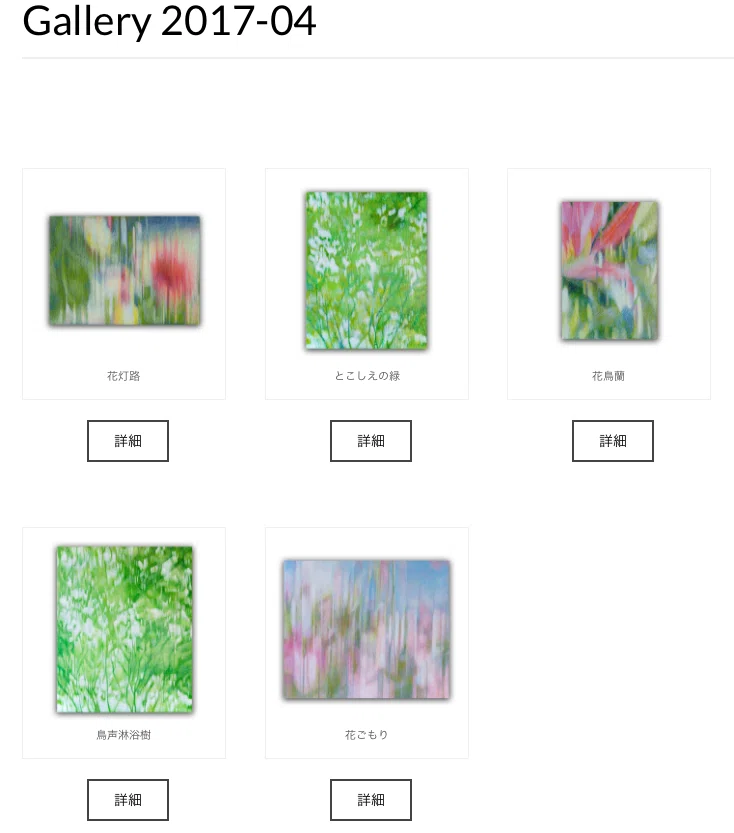
その3. 今後の活動の展望が少しずつ固まりつつあります。目標として、国際的な幅広い視野を持つ活動に切り換えて行くために、思い切って海外に出て活動することを決意しました。
それにともない、持ち物の断捨離及び、これまで制作した大作を少しでも売り、手放して行く努力をしています。また同時に最小限の作品と制作機材などを日本で保管維持して行くために、長期不在でも作品に影響が少ない気候の土地、かつ今よりも安い物件へと引っ越しをする計画を同時進行中です。本日仮契約まで進めて来ました。
今後もこのメルマガで、随時経過報告を行って参ります。どうぞこの目標に、是非ともご理解、ご賛同を頂き、引き続きお力添え、ご支援の程、よろしくお願い申し上げます。
(かわだゆうこ)
「画家川田祐子のニュースレター」は、
応援して下さる方々に向けて、
毎月5日に手動で配信するメルマガ・サービスです。
次号は5月5日の送信予定です。
YUKO KAWADA Official Site
http://kawadayuko.jp
English version
Painter Yuko Kawada’s Newsletter No.4
Late last month, while folding my hands in prayer at the roadside guardian deity (Dojojin) of a nearby shrine, I noticed a light, rhythmic tapping sound: tot-tot-tot. Looking up, I saw black and white stripes—a tiny woodpecker clinging vertically to a tree trunk. Against the clear blue sky, it flitted from branch to branch before disappearing from sight.
This month, a work using the tempera technique was finally completed. This technique involves thoroughly grinding pigments with fresh egg yolk and painting oil, then drawing fine lines with an ultra-fine brush. Although the egg yolk is yellow, it turns transparent as it dries, creating a remarkably durable paint with vibrant color output. The smooth flow of the paint also enables intricate line work. I hope you will click on the attached image to view the fine tempera line work.
April marks the beginning of a new season. I wish you all a fresh and fulfilling start.
Painter Yuko Kawada
“Cho-sei Rin-yoku Ju” (Tree of Showering Birdsong)
2017
oil and egg tempera on canvas
80.3×65.2cm
Artwork Details:
“Cho-sei Rin-yoku Ju” (Tree of Showering Birdsong)
Standing at the entrance of my studio is a large evergreen tree. Upon looking into it recently, I discovered it is an oak tree (Kashi).
During my student days, I had a dream about a majestic tree. Bathing in sunlight and sparkling brilliantly, its presence felt deeply cleansing. In the dream, someone told me it was the “Tree of Hourai”. I woke up with a firm resolve: “Someday, I will paint this.”
Such memories are often forgotten over time, but occasionally they resurface. “HOURAI,” presented in 2009, was the first artwork born from that dream. “Hourai” is a term that appears in The Tale of the Bamboo Cutter (Taketori Monogatari). When Princess Kaguya is courted, she asks her suitors for rare treasures that do not exist in this world, including the “Jeweled Branch of Hourai” (a branch with roots of silver, a stem of gold, and jewels of pearl). “Hourai” originally comes from the Chinese text Classic of Mountains and Seas (Shan Hai Jing), with various theories describing it as one of the five sacred mountains inhabited by immortals, or referring to the island of Taiwan. For me, however, that giant tree in my dream was the true symbol.
To me today, the oak tree at my entrance sometimes feels like that sacred tree of Hourai. As spring approaches, many birds gather here in the early morning. Their voices flow down over the great tree like a shower, expanding and contracting in all directions, creating an acoustic space where light seems to scatter inside transparent glass. Feeling that this auditory experience came to life in this artwork, I created the title “Cho-sei Rin-yoku Ju” (Tree of Showering Birdsong) using the phrase “Rin-yoku” (showering/bathing in Chinese).
My recent Tree Series emerges from these experiences. Taking a preliminary drawing created in February, I completed it in March using tempera and oil paint for the first time, assembling fine vertical strokes into a work dominated by shades of green. Prior to this F25-size piece, I also created an F5-size painting titled “Eternal Green,” where I experimented with scratch techniques.
Autobiography of Painter Yuko Kawada:
Cabbage Fields and Clouds in the Sky
For me, postage stamps served as the gateway to the world of art. As I collected stamps featuring famous paintings, I naturally developed an interest in art history. In addition to Western masterpieces, commemorative stamp series introducing Japanese national treasures were issued during the Tokyo Olympics and the World Expo. Accumulating them one by one expanded my artistic knowledge.
Our family’s Buddhist altar was designed by my father. Below the altar was a built-in bookshelf housing all 18 volumes of Shogakukan’s Grand Encyclopedia of Japan, alongside world and Japanese atlases. Back then, encyclopedias were wonderful tools for learning. Not only could I read about the masterpieces and painters I discovered on stamps, but the museums housing those artworks were also introduced. Although I couldn’t read the difficult characters, the abundance of color plates made me happy just looking through them. On that same shelf stood thick volumes titled Chronicles of Japanese Hometowns, which allowed me to research local histories, foods, and sightseeing highlights.
At the time, I didn’t think it strange that my father gave me so many stamps, but after he passed away in 2000, I learned the true reason. He had been purchasing them to support the sales quota of a former student who had taken a job at the post office. I kept those stamps carefully stored in albums for many years, later utilizing them when mailing direct mail cards for my solo exhibitions.
My father doted on me, frequently taking me to museums and bookstores from a young age. Tokyo National Museum, The National Museum of Western Art, Tokyo Metropolitan Art Museum, The National Museum of Modern Art Tokyo, and The Museum of Modern Art Kamakura—these were places I visited frequently even before entering elementary school. Bookstores like Hirasaka Books in Yokosuka, Kobundo, and Yurindo at Sakuragicho in Yokohama were regular stops. In the basement of Yurindo Sakuragicho, there used to be a gallery café displaying small oil paintings, while a large nude painting was displayed in the open atrium above. The Miura Peninsula, where we lived, was blessed with nature, featuring both sea and mountains. We often went hiking along nearby coasts, Mount Take, and Mount Miura-Fuji.
There was also a time when my father taught me how to paint. It was around my second year of elementary school. One day, my mother’s youngest sister (the youngest of six sisters) needed to complete an art assignment for her teaching license and came to my father for lessons in landscape painting. My father brought out oil paints and canvases he had stashed in the shed, handed me watercolors and a sketchbook, and took us to a nearby cabbage field.
Standing before the two of us, my father explained: “A painting needs a structural framework called composition. It’s best to plan the overall layout before you start painting.” After that, we painted freely in our chosen spots while he walked back and forth between us. After a while, we lined up our artwork to view them from a short distance. I was astonished to see how two paintings of the exact same cabbage field could turn out so completely different! My aunt’s painting depicted individual cabbages in meticulous detail, but she seemed dissatisfied, saying, “I really want to paint cabbages so they look like cabbages—teach me how to do that!”
My father responded: “The goal of a landscape painting is not to depict each individual cabbage, but to capture it as a single, unified scene.” He then praised me, saying, “In that respect, Yuko’s painting is wonderful.” Although I couldn’t paint cabbages in detail, capturing the vast expanse of sky and cabbage fields felt exhilarating and made me love drawing even more. The concept of “sensing something as a unified landscape” left a profound impression on my young mind that remains with me today. However, that was both the first and last time my father taught me painting. After that, he strongly disapproved of my painting, often repeating: “You can’t make a living as a painter.”
In that sense, while I received unforgettable benefits from my father, not everything was positive. That was reality, and it was important for me… though as a child, it felt cruelly hard to see it that way.
The elementary school I attended was about a five-minute walk from home. Set on a stone embankment, it had an unusual entrance at the time with long staircases of over 40 steps leading up both left and right sides. At the top stood subtropical cycad trees. When I first entered school, we played rock-paper-scissors on those stairs, moving up and down to games like “Glico,” “Pineapple,” and “Choki-choki-basami”. Near the top of the stairs, you could overlook the nearby sea. My memories are filled with scenes of sparkling sky and water. The schoolhouse was a nostalgic wooden structure with coal stoves placed at the back of classrooms in winter.
One day during class, the teacher asked: “Why do clouds in the sky move?” I confidently raised my hand right away.
Just the day before, my father and I had discussed the same topic on a walk. He had asked me, “Why do you think clouds move?” and I replied, “Because the wind blows, right?” But he told me, “That answer isn’t good enough.” I thought hard, but couldn’t come up with anything else. Then he declared with supreme confidence: “Clouds move because the Earth is spinning. It’s proof that humans are alive!” I didn’t fully understand the last part, but having heard somewhere that the Earth rotates, I accepted his explanation earnestly.
The teacher called on me, and I announced with absolute confidence: “Because the Earth is spinning!” In an instant, the classroom erupted in laughter. I couldn’t understand why everyone was laughing. When someone else answered, “No, it’s because the wind blows,” and the teacher confirmed, “That is the correct answer,” the blood drained from my face, making me feel physically ill. From that day on, I lost trust in my father.
I had been taking calligraphy lessons from him, but I suddenly declared I was quitting. Furious, he shouted, “Don’t you ever ask to learn again!” and grew increasingly quiet from then on.
Unfortunate events continued to compound. At some point, a dark, heavy atmosphere descended upon our home. One day, my mother revealed the reason to me… (To be continued in the next issue)
Q & A: Artwork as Depreciable Assets
Recently, I received a newsletter from Mr. Koichi Yamashita, a painter living in Matsumoto who continues to paint the mountains of Shinshu. He shared information regarding “Artworks as Depreciable Assets,” which I would like to pass along here:
Did you know?
Since January 1, 2015, artworks purchased by corporations for 1,000,000 yen or less qualify for tax depreciation (classified as interior decoration under “Equipment and Fixtures”). For paintings, the statutory useful life is 8 years (straight-line or 200% declining-balance method). Framing costs, transportation, and installation fees can be included in the acquisition cost, and items in storage qualify if they are in a displayable condition. Additionally, artworks under 300,000 yen can be fully written off in a single year (up to 3,000,000 yen per fiscal year). For details, please consult the National Tax Agency website’s FAQ regarding depreciable art assets.
Mr. Koichi Yamashita will hold a solo exhibition this September at the Matsumoto City Museum of Art Multipurpose Hall, presenting works accumulated over the past 30 years. Congratulations, Mr. Yamashita! If you are in the area, please consider visiting.
You can also visit Mr. Yamashita’s blog, Painting and Travel (E to Tabi).
Announcements
1. Collectors Collection Page Update
With his permission, a new page titled “Shozo Tani Collection” has been added to the “Collectors Collection” section of the official website.
2. New Works Gallery (Gallery2017-04)
A new page showcasing works created in March has been added to the official site.
3. Future Activity Plans
The outline for future activities is taking shape. To transition toward an international perspective, I have made the decision to venture abroad.
Accordingly, I am downsizing my possessions and making efforts to sell and part with some of my larger past works. Simultaneously, to store and maintain essential artworks and equipment in Japan, I am planning a move to a location with a favorable climate for artwork preservation and lower costs during extended absences. I completed a provisional contract today.
I will continue to report progress through this newsletter. I deeply appreciate your understanding, resonance, and ongoing support for these goals.
(Yuko Kawada)
“Painter Yuko Kawada’s Newsletter” is a monthly newsletter service manually sent on the 5th of every month to supporters and patrons.