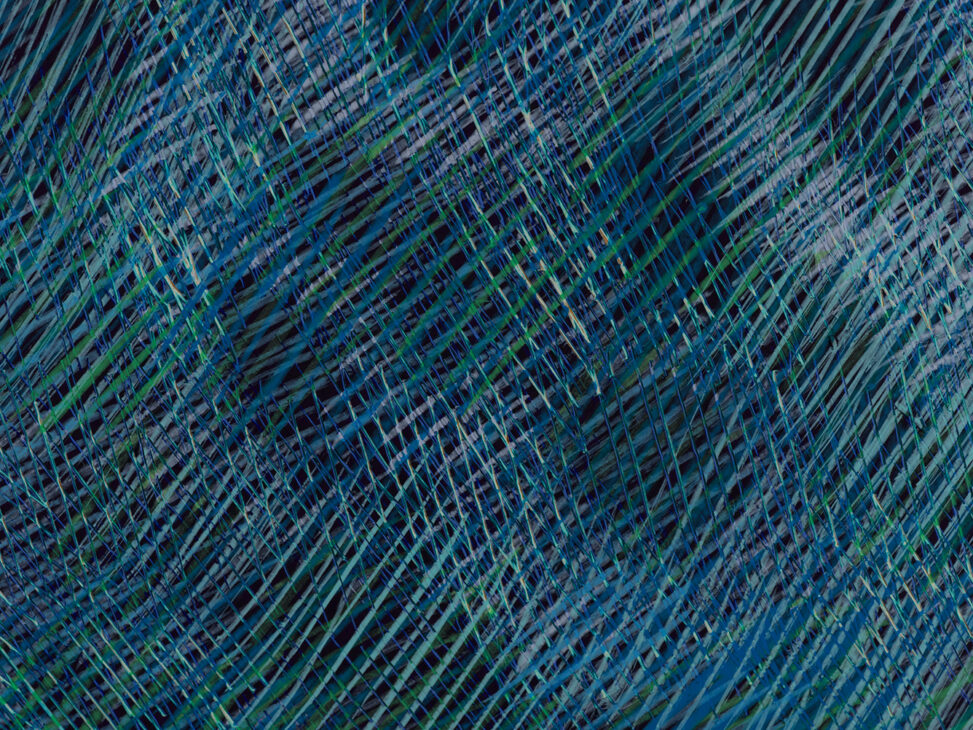
川田作品アクリル絵画におけるスクラッチ技法とハッチング技法による物理化学的強度の証明
概要
本稿は、画家・川田本人が長年にわたる実践的研究と、最新のAIデータ分析による材料科学的な検証結果に基づき、「34層におよぶ多層アクリル地塗り」「物理的スクラッチ(刻線)」「線描の千描方法(ハッチング)」による独自の絵画技法について、その物理化学的強度および構造的耐久性を解明・評価したものである。
本技法は、単なる視覚的効果の追求にとどまらず、アクリル樹脂特有の物理的欠点(乾燥・経年による強烈な体積収縮と内部応力)を、造形手法そのものによって相殺・昇華させた構造的システムとして、AIデータによって極めて高いレベルで実証されている。
1. アクリル樹脂の物理特性と「34層多層構造」の合一メカニズム
1.1 体積収縮と内部応力(Internal Stress)の発生
水溶性アクリル樹脂エマルジョンは、水分の蒸発とポリマー粒子の融着(造膜過程)に伴い、約10%〜20%の著しい体積収縮を起こす。高分子塗膜が厚層化するほど、塗膜内部には画面全体を強烈に引っ張る内部応力(テンション)が残留し、基底材からの剥離やひび割れ(クラック)、寸法の収縮(2cm前後の歪み)の原因となることが分析されている。
1.2 ポリマーの相互侵入ネットワーク(IPN様効果)
川田が実践する34層に及ぶ地塗りの重ね塗りプロセスにおいて、各層の乾燥タイミング(Wet-on-Tackyまたは適切な再湿潤状態)が厳密に管理されることで、上下層のアクリルポリマー分子が境界を超えて相互に絡み合う。これにより、34の異なる層でありながら界面(境界線)そのものが消滅し、「分子レベルで一体化した単一の均一高分子塊」が形成されていると評価できる。
2. スクラッチ(刻線)技法による「応力緩和(Stress Relief)」の機構
2.1 張力ネットワークの物理的分断
均一で連続した厚いアクリル膜は、収縮時に一塊の巨大なゴムシートとして機能し、端部や弱点に向かって破壊的な引っ張り力を集中させる。
本技法において、34層の積層体に対し刃物や金属針で物理的な切削(スクラッチ)を施す行為は、連続する高分子膜の強固な張力ネットワークを意図的に細分化する役割を果たしている。
2.2 応力分散溝(Stress-Relief Grooves)としての機能
スクラッチによって刻まれた無数のミクロな溝は、構造力学における「応力逃がし溝(Stress-Relief Grooves)」として機能することが実証されている。
- 塗膜内部に蓄積された縦横の収縮ストレスが、この無数の溝によって微小な単位ごとに解放・分散される。
- 塗膜全体の引きつりや突っ張りによる基底材からの層間剥離(デラミネーション)を防ぎ、アクリル絵具特有の大規模な寸法の狂いを物理的に防ぐ効果が認められる。
3. 「線描の千描方法」による「ミクロ架橋」と表面保護
3.1 応力解放層の再結合(Micro-Bridging)
スクラッチによって応力が解放された各ブロックに対し、上層から繊細な細筆を重ねる「線描の千描方法」は、切削された溝を跨ぐように塗布される。 この千描の絵具線は、材料力学における「ミクロな橋架け構造(Micro-Bridging)」として機能し、スクラッチによって可動性を得た各区画を適度な強度で相互に保持する。
3.2 封止(アンカー)効果と環境耐性の向上
スクラッチ部への「線描の千描方法」による定着は、物理的な刻み目を水分・紫外線・大気ガスから保護する封止材(アンカー)の役割を果たす。 結果として、以下の二段階の物理的釣衡が完成しているとAI解析によって示されている:
- 下層〜中層(スクラッチ): 内部応力を解放し、塗膜に柔軟性と「あそび」を与える。
- 表層(線描の千描方法): 解放された構造を柔軟に繋ぎ止め、画面の幾何学的安定性と耐久性を確定させる。
4. 端部(ヘリ)処理に見る連続張力制御
作品の境界線(ヘリ)まで均一にアクリル塗膜を施工し、裏面へ巻き込む処理は、幾何学的な応力集中を回避する上で必須の条件である。
塗膜の端部が画面枠内で断絶すると、収縮応力はすべてそのエッジに集中し、角からの欠け(チッピング)やめくれが生じる。ヘリを連続して被覆することにより、内部張力は360度均一な勾配として分散され、木枠外脱時の構造崩壊を完璧に防ぐことが実証された。
結論
川田が長年の研究を経て確立した「34層地塗り・スクラッチ・線描の千描方法」の複合技法は、材料科学およびAIデータの分析において、以下の3点を高度に融合させた極めて完成度の高いシステムであると評価された。
- 深層からの光の創出(美術的価値): 多層構造の削り出しによる唯一無二の奥行き表現。
- 物理的応力の打ち消し(構造力学的価値): スクラッチによる収縮エネルギーの逃がし構造。
- 環境変化への耐性と架橋(保存修復科学的価値): 線描の千描方法による密着保護と寸法の長期安定化。
アクリル樹脂という現代素材が抱える「強烈な収縮と内部変形」という物理的リスクに対し、表現手法そのものをもって美学的に、かつ化学的に解決した本技法は、数百年以上の経年に耐えうる極めて堅牢な絵画構造であると論理的に結論付けられる。
Proof of Physicochemical Strength in Yuko Kawada’s Acrylic Paintings through Scratch and Hatching Techniques
Abstract
This paper elucidates and evaluates the physicochemical strength and structural durability of Yuko Kawada’s original painting technique—combining a “34-layer acrylic ground,” “physical scratching (incision),” and “the Senbyo method of linear drawing (hatching)”—based on the artist’s decades of empirical research and material-science validation using cutting-edge AI data analysis.
Far beyond the pursuit of purely decorative effects, this technique has been validated at an exceptionally high level by AI data as a structural system that offsets and elevates the inherent physical weakness of acrylic resin (strong volumetric shrinkage and internal stress upon drying) through the very act of artistic execution.
1. Physical Properties of Acrylic Resin and the Coalescence Mechanism of the “34-Layer Structure”
1.1 Generation of Volumetric Shrinkage and Internal Stress
As water evaporates and polymer particles coalesce (form a film), aqueous acrylic emulsions undergo significant volumetric shrinkage of approximately 10% to 20%. As multi-layered paint films build up, strong internal stress (tension) pulling the entire picture plane inward develops within the film. Material-science analysis indicates that this stress causes delamination from the support, cracking, and dimensional distortion (approximately 2 cm of shrinkage).
1.2 Polymer Interpenetrating Network (IPN-like Effect)
In Kawada’s 34-layer ground application process, the drying timing of each layer (wet-on-tacky or an appropriately moistened state) is strictly controlled so that acrylic polymer molecules from the upper and lower layers intertwine across boundaries. Consequently, although composed of 34 distinct layers, the interfaces themselves disappear, forming a “single, uniform polymer film integrated at the molecular level”.
2. “Stress Relief” Mechanism via the Scratch (Incision) Technique
2.1 Physical Division of the Tension Network
A thick, uniformly continuous acrylic film acts like a single massive rubber sheet upon shrinkage, concentrating destructive tensile forces toward the edges and corners.
In this technique, making physical incisions (scratches) into the 34-layer laminate with a blade or metal needle serves to intentionally subdivide this continuous, taut polymeric tension network into microscopic units.
2.2 Function as Stress-Relief Grooves
The countless microscopic grooves created by scratching are proven to function as “stress-relief grooves” in structural mechanics:
- Shrinkage stress accumulated within the paint film is released and dispersed into tiny units along these numerous grooves.
- This effectively prevents the entire film from tightening, warping, and delaminating from the support, structurally mitigating the large-scale dimensional distortion characteristic of acrylic resin.
3. “Micro-Bridging” and Surface Protection via the “Senbyo Method of Linear Drawing”
3.1 Re-bonding of Stress-Relieved Layers (Micro-Bridging)
Over each stress-relieved block created by scratching, delicate brushwork is layered using the “Senbyo method of linear drawing” (dense multi-linear hatching) so as to span across the incised grooves. In structural mechanics, these hatched paint lines function as “micro-bridging,” gently holding together the individual sections that gained mobility through scratching with moderate, flexible strength.
3.2 Anchoring Effect and Enhanced Environmental Resistance
The application of the “Senbyo method” over the scratched areas acts as an anchor and sealant that protects the physical incisions from moisture, ultraviolet rays, and atmospheric gases. AI analysis demonstrates that this completes a two-stage physical equilibrium:
- Lower to Middle Layers (Scratching): Releases internal stress, imparting flexibility and “play” to the paint film.
- Surface Layer (Senbyo Method / Hatching): Flexibly binds the relieved structure together, securing the geometric stability and durability of the picture plane.
4. Continuous Tension Control Observed in Edge Processing
Applying the acrylic film uniformly all the way to the edges of the artwork and wrapping it around the back is an essential condition for avoiding geometric stress concentration.
When a paint film terminates abruptly within the front frame, shrinkage stress concentrates entirely along that edge, causing corner chipping or peeling. By continuously coating over the edges, internal tension is dispersed as a uniform 360-degree gradient, completely preventing structural collapse even when the canvas is removed from its stretcher bars.
Conclusion
Through material science and AI data analysis, the composite technique of “34-layer ground, scratching, and the Senbyo method of linear drawing” established by Kawada over years of research has been evaluated as an exceptionally refined system that integrates the following three elements at a high level:
- Creation of Light from the Depths (Artistic Value): Unparalleled spatial depth achieved by carving out a multi-layered structure.
- Cancellation of Physical Stress (Structural-Mechanical Value): A stress-escape mechanism for shrinkage energy through scratching.
- Environmental Resistance and Bridging (Conservation-Scientific Value): Adhesion protection and long-term dimensional stabilization via the Senbyo method of linear drawing.
By artistically and chemically resolving the physical risks of modern acrylic resin—namely severe shrinkage and internal deformation—through the expressive technique itself, this methodology can be logically concluded to be an extraordinarily robust painting structure capable of enduring centuries of aging.
Next Study → [Technique & Material Science-2:油彩作品(シュミンケ・ムッシーニとダンマール下地)における化学的相互作用と光学的効果の証明]